
By Josh Shepherd
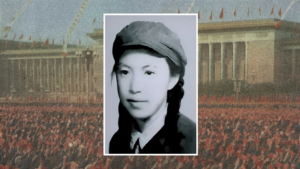
Nearly six decades after Mao Zedong’s government executed Lin Zhao, a 36-year-old Christian journalist who stood against Communist rule, Chinese authorities still regard her as a threat.
“Lin Zhao poses a serious challenge to the Chinese regime,” said historian Lian Xi, a distinguished professor of world Christianity at Duke Divinity School who also teaches at Harvard Divinity School.
Lian spent seven years researching Lin’s life for his definitive biography, Blood Letters. Once an ardent supporter of Mao’s Communist revolution, Lin became an outspoken critic, writing protests in her own blood while imprisoned before her execution in 1968.
Decades later, authorities installed surveillance cameras and a steel gate at her tomb, and some mourners have been jailed. “The regime is paranoid about her legacy,” Lian said.
Today, her legacy lives on through ChinaAid’s Lin Zhao Freedom Award, presented since 2018 to Chinese advocates defending human rights and religious freedom. The annual award, which includes a financial prize, honors those demonstrating similar courage in confronting injustice.
In this lightly edited interview, Professor Lian recounts Lin’s extraordinary life and explains why her example speaks to believers and other defenders of freedom today.
DRAWN INTO A UTOPIAN MOVEMENT
1. When you began researching Lin Zhao, what convinced you the story of this courageous young woman would be worth years of work?
Lian Xi: During almost three decades of Mao’s rule in China, tens of millions were victims of the Great Famine and violent political campaigns. Most were silent victims with no agency.
What struck me when I stumbled upon her story was that Lin Zhao was a victim yet she had a voice. It was a distinctive Christian voice that speaks to human dignity and human freedom.
The fact that she was this lone, open dissident is important in modern Chinese history. Lots of people were closet dissidents. Regardless of her gender, Lin Zhao stood up with a sense of moral Christian duty against communism. When she saw evil, she named it and opposed it.
2. What initially attracted Lin Zhao and so many other young people to Mao’s movement?
Lian Xi: Looking back and having seen the atrocities that communism brought to the Soviet Union and China, it is difficult for us to see how an idealist with a strong sense of morality could be drawn to the Communist movement.
But in Lin Zhao’s time, she was not alone in connecting her Christian sense of justice with the Communist search for justice.
Before the Communists came to power, they promised a new heaven and a new earth, a completely just society, an end to exploitation, and an end to political repression. It was very attractive to a young idealist like her.
BRUTAL MOVEMENT, BOLD FAITH
3. What led her to change from a devoted supporter to an outspoken critic of Mao?
Lian Xi: It took quite a journey to turn from her idealism. Lin faced personal attacks by Communist cadres, and she experienced sexual exploitation by those who claimed to serve the people and represent Communist morality. The party retaliated against her, yet she still called Mao her father.
Only after the Anti-Rightist Campaign, when Lin Zhao witnessed a generation of patriotic, idealistic young people victimized and branded enemies of Mao’s revolution, did her hope collapse. She herself was denounced as a rightist, dashing her last hopes in the movement.
Mao claimed to implement a kind of “proletarian” dictatorship for a virtuous cause—the liberation of humanity and all that. The reality Lin Zhao eventually came to face is that one-party dictatorship is the Chinese Communist Party’s first and last goal. It still is.
4. How did Lin Zhao’s Christian convictions shape her resistance?
Lian Xi: Her Christian faith went through different stages, being challenged and tested. After she joined the Communist movement, she desperately wanted to prove her loyalty. She threw herself into political land reform, taking part in a very violent movement against class enemies.

So, I’m not sure she lost her Christian faith, but she drifted away from the church and had to suppress her Christian practice as part of that Communist movement.
After she was denounced as a rightist in 1958, even though it was a difficult and dangerous time for her, Lin started going back to church.
From that point on, particularly after she was thrown into prison and openly opposed Mao, only her Christian faith provided a support strong enough for her opposition.
In prison, Lin Zhao took her faith very seriously. She had what she called a one-person “grand worship” in her cell every Sunday morning. Under the most extreme circumstances, she still recalled the Bible and sang hymns.
Her private spiritual life fueled her public stand on matters of principle and justice. She had the conviction that this was a fight she had a responsibility as a Christian to carry on.
5. Why did Lin Zhao write in her own blood, and what does this reveal about her convictions?
Lian Xi: Part of this was a matter of necessity. When her writing instruments were taken away from her, her blood was the only ink available.
But blood writing is also an extreme form of protest that goes back more than a thousand years. It’s a Chinese tradition associated with religious devotion, as a way to express one’s determination and resolve. Both of those were at play in her writings.
Lin Zhao saw her struggle in prison as a spiritual battle. She said she was sticking to her path, as she called it, the “political line of Christ,” the line of God’s servant.
The blood writing, and the extremity of that expression, were connected to her sense that this was a spiritual battle and she needed to go all out.
HER VOICE FOR JUSTICE AND FREEDOM STILL SPEAKS
6. How has the Chinese government’s treatment of Lin Zhao’s memory changed since Mao’s death?
Lian Xi: After years of imprisonment and torture, Mao’s government executed her. What’s interesting is how the government’s treatment of her legacy reflects changes in post-Mao China. Under Deng Xiaoping, the party tried to win back the people’s trust.
In the early 1980s, the Chinese Communist Party tried to reclaim its political legitimacy by revisiting wrongful persecution cases. Lin Zhao’s case was reviewed, she was pronounced innocent, and her prison writings were returned to her family. Thanks to those efforts, we know the details of her story.
Unfortunately, we see another reality in contemporary China: the government’s response to people who want to commemorate her.
One turning point came in 2008, the 40th anniversary of her execution and the year of the Beijing Olympic Games. Seeking to protect its image, the regime installed a surveillance camera above her tomb to discourage public commemoration.
I saw the camera when I visited her tomb in 2013. Later, authorities erected a steel gate to block access.
On April 29, the anniversary of her death, police have broken up gatherings, detained visitors, roughed some up, and charged others. In 2018, one visitor crawled under the gate to leave a bouquet of flowers at her tomb. He was imprisoned for four years.

7. ChinaAid’s Lin Zhao Freedom Award links her legacy with today’s prisoners of conscience. Why do you think this connection is important?
Lian Xi: In China, under almost impossible circumstances of hardship and brutal persecution, so many people stand up for justice, the rule of law, human rights, and religious freedom today. Yet they are very lonely.
Tens of millions of Christians are in China, yet they have no network of support and nowhere to give voice to their struggles. Such issues aren’t allowed to be discussed in the official Three-Self churches. And the unofficial churches, now returning to underground status, are often preoccupied with their members’ struggle for survival.
Even today, in the Chinese evangelical Christian community, some fear getting tangled in politics. Yet Lin Zhao showed there are times when it’s simply impossible to maintain a dividing line between faith and politics.
With this award initiative, I appreciate that ChinaAid is seeking to remind people in extreme loneliness that they are not alone. Examples like Lin Zhao have come before them, speaking out with faith for what they believe is right.
The message that they are not forgotten and not alone can bring crucial, vital help and support in moments that are otherwise quite hopeless.
Learn more about the Lin Zhao Freedom Award, including how to submit a nomination.
Josh Shepherd is editor of ChinaAid News. Founded in 2002, ChinaAid is an international Christian human rights organization committed to promoting religious freedom and the rule of law in China through advocacy, legal support, and international awareness campaigns.