(MIDLAND, Texas — Press Release — September 30, 2026) — A Chinese court has sentenced eight people associated with Create Abundance, a nationwide spiritual-development and commercial network, to seven to nine months in prison under China’s Criminal Law Article 300.
The case, centered in northeast China, has also resulted in the closure of hundreds of affiliated lifestyle centers and the seizure or freezing of substantial assets. Information provided to ChinaAid indicates that companies and individuals who were not criminal defendants were also affected by enforcement measures.
Create Abundance is a spiritual-development network whose participants reportedly came from diverse religious and spiritual backgrounds, including Protestant Christianity, Catholicism, Islam, Buddhism, Hindu traditions and Falun Gong. ChinaAid says the case raises religious-freedom concerns because ideological assessments of spiritual teachings were reportedly used in the prosecution.
Several Create Abundance members and other affected individuals have reportedly left China, with some seeking protection or asylum in the United States and Italy.
ChinaAid Founder and President Rev. Dr. Bob Fu said authorities should distinguish between provable criminal conduct and protected belief.
“If anyone committed fraud, coercion, or another recognizable crime, the government should prove that offense with credible evidence in a fair and independent court,” Fu said. “But idealism, theism, spiritual teaching, or belief in God cannot themselves be transformed into crimes simply because they contradict the Chinese Communist Party’s official Marxist ideology.”
Eight sentenced under Article 300
According to publicly available Chinese reports, the Xinmin Municipal People’s Court in Liaoning Province tried eight defendants on Jan. 9, 2025, for “using superstition to undermine the implementation of law.”
The court later sentenced them to seven to nine months in prison and imposed fines. Chinese state-linked reporting says none appealed and the judgments became effective.
Authorities characterize the defendants as important members of a criminal organization headed by Create Abundance founder Zhang Xinyue, legal name Zhang Dachen. They allege the organization promoted “cosmic energy,” spiritual healing and other practices authorities characterize as superstition, and that members suffered financial and other harms.
Create Abundance strongly disputes that account. Its representatives maintain that affiliated businesses were legally registered, services and courses were openly offered, and the prosecution criminalized spiritual teachings and beliefs rather than proven criminal conduct.
Article 300 reaches beyond ‘cult’ cases
ChinaAid notes that Article 300 should not simply be described as China’s “cult law.” The statute criminalizes organizing or using huidaomen, organizations officially classified as xiejiao, or superstition to undermine implementation of state laws or administrative regulations.
The law allows three to seven years in prison for ordinary offenses, harsher penalties for “especially serious” cases and less than three years or other penalties for relatively minor cases. A 2017 judicial interpretation also defines organizations authorities may classify as xiejiao.
The seven-to-nine-month sentences indicate authorities treated the defendants’ conduct as falling within Article 300’s “relatively minor” category. In this case, prosecutors relied on the statute’s separate “use of superstition” provision rather than solely on classification of an organization as xiejiao.
Case reaches nationwide network
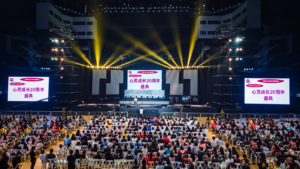
Create Abundance developed over roughly two decades into a large network of “Luxury Life Art Centers.” Representatives say the network at its height included nearly 1,000 centers in more than 500 Chinese cities and about 400,000 participants or members.
The centers combined commercial and personal-development activities, including cafés, tea houses, reading spaces, restaurants, business training and spiritual or personal-growth courses. Representatives say the centers operated through legally registered businesses, held business licenses, disclosed fees and paid taxes.
Chinese authorities offer a sharply different account. State-linked reports describe Create Abundance as a harmful “spiritual training” organization that used teachings about cosmic energy, healing, wealth and spiritual development to attract followers and obtain large amounts of money.
The central dispute is whether alleged commercial misconduct was established through ordinary criminal evidence or whether unconventional spiritual beliefs became a basis for criminal liability.
Ideological reviews draw religious-freedom concerns
Materials reviewed by ChinaAid indicate that ideological assessments of Create Abundance publications played a significant role in the case. Books and instructional materials, including Spiritual Growth and The Wisdom of Growth, were reportedly examined for ideological content.
According to case information provided to ChinaAid, assessments criticized the materials for promoting idealism, theism, faith-based teachings and ideas inconsistent with Marxist materialism, alongside allegations of distorted values and psychological or spiritual control.

ChinaAid says using such conclusions in a criminal proceeding raises questions about whether authorities were punishing demonstrable criminal conduct or people holding spiritual beliefs.
“When ideological assessments become evidence of criminality, every independent religious or spiritual community in China has reason to be concerned,” Fu said.
The case also implicates internationally recognized protections for freedom of thought, conscience and religion and fair-trial rights. Article 18 of both the Universal Declaration of Human Rights and International Covenant on Civil and Political Rights protects freedom of thought, conscience and religion. China signed the ICCPR in 1998 but has not ratified it.
Asset seizures extend beyond defendants
Information supplied to ChinaAid indicates that enforcement measures extended beyond the eight convicted defendants to more than 40 civil parties, reportedly including 38 companies and three individuals.
Approximately RMB 30 million in cash, seven properties in Shanghai and additional assets reportedly worth hundreds of millions of renminbi were frozen, seized, confiscated or otherwise subjected to enforcement measures.
Representatives of affected parties allege that some companies and individuals lost assets without adequate legal notice or a meaningful opportunity to participate in court proceedings, contest the seizures or pursue effective appeals.
ChinaAid has not independently verified the full value or legal status of every asset reportedly seized and says the allegations warrant independent investigation and disclosure of relevant court and enforcement records.
The Universal Declaration of Human Rights also recognizes protection against arbitrary deprivation of property, adding a separate due-process concern for companies and individuals who were not defendants in the criminal case.
ChinaAid seeks records and due process
ChinaAid calls on Chinese authorities to:
1. Publish the complete judgments and evidentiary basis underlying the convictions of the eight defendants;
2. Identify the specific laws or administrative regulations the defendants allegedly obstructed, as required by the wording of Article 300;
3. Distinguish protected religious and spiritual expression from independently provable criminal conduct;
4. Provide affected third parties meaningful judicial procedures to challenge asset seizures;
5. Return property that cannot be demonstrated through lawful proceedings to constitute criminal proceeds or property legally subject to confiscation; and
6. Protect the freedom of thought, conscience, religion and belief of all individuals associated with the case.
ChinaAid said it will continue investigating the case and documenting the treatment of Create Abundance members, affiliated businesses and affected families.
“Article 300 has long provided Chinese authorities with extraordinarily broad power over communities of faith and conscience,” Fu said. “No peaceful citizen should lose liberty or property merely for holding beliefs the Communist Party does not approve.”
Founded in 2002, ChinaAid is an international Christian human rights organization committed to promoting religious freedom and the rule of law in China through advocacy, legal support, and international awareness campaigns.