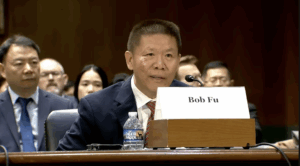

Congressional-Executive Commission on China (CECC), United States Congress
- Hearing Date: November 20, 2025
- Location: 562 Dirksen Senate Office Building, Washington, D.C.
- Chair: Senator Dan Sullivan
- Co‑Chair: Representative Chris Smith
—— Written Testimony Submitted for the Record ——
Submitted by Dr. Bob Fu, Founder and President of ChinaAid
I. CCP POLICIES AND TACTICS OF COERCIVE RELIGIOUS CONTROL
The Chinese Communist Party (CCP) has escalated its campaign against religious communities into a comprehensive, nationwide strategy aimed at eliminating all forms of independent faith. This represents not merely a continuation of repression but the emergence of a new, more totalizing phase of ideological and legal control.
The CCP’s objective is clear: to subordinate all religious expression to Communist Party authority and to eradicate any spiritual allegiance that competes with the Party’s supremacy. This applies especially to Uyghur Muslims, Christians, Tibetan Buddhists, and other communities the CCP deems “politically untrustworthy” or “susceptible to foreign influence.”
This new phase is defined by four major trends:
1) criminalizing normal church finances,
2) outlawing online worship,
3) targeting believers involved in overseas Christian activities, and
4) restricting minors from any exposure to religious teaching.
These tactics work together to produce an unprecedented level of coercive control over religious life in China.
A. CRIMINALIZING TITHING, OFFERINGS, AND NORMAL CHURCH FINANCES
One of the most alarming trends in this new phase of repression is the CCP’s transformation of ordinary church finances—such as tithes, offerings, and benevolence funds—into alleged criminal activity.
Historically, the state targeted house churches primarily by raiding gatherings or shutting down worship spaces. But as Christians adjusted by meeting in smaller groups or online, the CCP shifted its tactics toward financial criminalization—seeking to dismantle churches at their roots by attacking their ability to function.
1. Fabricating charges of “fraud” and “illegal business operations”
Under this strategy, local Public Security Bureaus and prosecutors now routinely accuse pastors and church leaders of: illegal business operations (非法经营罪), fraud (诈骗罪), illegal fundraising, misappropriation of funds, or financial deception, even when no evidence of wrongdoing exists.
These charges are used not because churches are financially improper, but because they provide a convenient legal pretext for detaining pastors, freezing bank accounts, and confiscating church property.
2. The Linfen Golden Lampstand Church cases: Yang Rongli (杨荣丽) and Wang Xiaoguang (王晓光)
A stark example of this financial repression is the extreme sentencing of the leaders of Golden Lampstand Church (金灯台教会) in Linfen, Shanxi Province.
Pastor Yang Rongli (杨荣丽) was sentenced to 15 years, one of the longest sentences imposed on a Christian leader since the Cultural Revolution.
Her husband, Pastor Wang Xiaoguang (王晓光), received nearly 10 years, along with crippling fines.
Their “crime” was receiving and administering donations and offerings—standard pastoral responsibilities in any church worldwide. No victims were identified, no illegal profit was alleged, and no misappropriation was proven.
3. A nationwide campaign against church finances
The Golden Lampstand cases are not isolated. Similar charge patterns have been used against leaders from:
– Early Rain Covenant Church (秋雨圣约教会)
– Beijing Zion Church (北京锡安教会)
– Shouwang Church (守望教会)
– Xunsiding Church (巡司顶教会)
– House churches in Henan, Anhui, Guizhou, and Fujian.
In each case, financial accusations serve as a powerful weapon to imprison pastors and place entire congregations under threat.
4. The purpose: starve the church into submission
By criminalizing normal Christian giving, the CCP seeks to: drain the financial lifeblood of faith communities; bankrupt churches through fines and asset seizures; remove pastoral leadership; prevent the funding of missions, humanitarian work, and discipleship; and create fear around offering or receiving donations.
The CCP knows that when it cannot destroy the church through theology or ideology, it can attempt to destroy it through financial strangulation.
B. CRIMINALIZING ONLINE WORSHIP, PRAYER, AND DIGITAL FELLOWSHIP
China has enacted some of the most restrictive digital-religion laws in the world. Beginning in 2022 and accelerating through 2025, the CCP introduced a series of regulations that effectively criminalize online Christian activities, including worship, prayer meetings, Bible studies, devotional livestreams, and sharing Scripture online.
1. The 2024–2025 Regulations on Religious Information on the Internet
These regulations require:
– A state-issued “Religious Information Services License” for any online religious content.
– Licenses available only to government-sanctioned churches.
– Automatic exclusion of nearly all Protestant house churches.
– Criminal penalties for posting Scripture, sermons, worship music, or online fellowship without approval.
2. Nationwide arrests and detentions for online faith
Dozens of pastors and believers have been detained for leading WeChat prayer groups, Zoom Bible studies, and morning devotional livestreams. Beijing Zion Church’s online devotional, joined by more than 10,000 believers each morning, was used as evidence of “illegal influence” before the October 9, 2025 arrests.
3. Digital faith treated as a national-security threat
The CCP frames unregulated online religious content as “ideological infiltration” and a threat to social stability. Ordinary pastors and young believers are now treated as potential subversives for participating in digital worship—activities common in free societies around the world.
C. CRIMINALIZING OVERSEAS CHRISTIAN ENGAGEMENT AND MISSION WORK
A third major trend is the CCP’s escalating punishment of believers who participate in overseas Christian activities. This includes theological conferences, mission training, Bible exposition events, or fellowship with Christian organizations abroad.
1. Evangelist Dong Yumei (董玉梅)
Evangelist Dong Yumei, General Secretary of the United Evangelism Fellowship (中国联宣), was arrested in Beijing on March 23, 2025, after returning from mission-related activity overseas. She is now detained at Jiangyou Detention Center (江油市看守所), and the Procuratorate has formally approved her arrest — signaling the intention to prosecute her.
Her case shows that any Christian participating in global mission work risks criminal prosecution.
2. Surveillance and interrogation of returning travelers
Chinese Christians returning from conferences in South Korea, Singapore, Taiwan, Malaysia, and the United States report:
– Phone and device searches
– Passport confiscation
– Hours-long interrogations
– Threats against employers or family members
– Placement under “residential surveillance” (RSDL)
3. Treating global Christianity as a threat
The CCP views international Christian connections as potential “foreign infiltration.” Ordinary mission trips, Bible workshops, or prayer retreats are now treated as national-security concerns. This policy intends to isolate Chinese Christians from global fellowship and weaken the global body of Christ by severing China from the rest of the Christian world.
D. PREVENTING MINORS FROM ACCESSING THE BIBLE OR ANY RELIGIOUS LIFE
The CCP is aggressively enforcing a nationwide prohibition on minors’ participation in any religious activity. This policy aims to ensure that Christianity and other faiths “naturally die out” within one generation.
1. Banning all youth religious involvement
Since 2018, authorities have:
– Prohibited minors from entering churches
– Shut down Sunday schools and youth camps
– Pressured schools to report Christian families
– Threatened parents who teach the Bible at home
2. The case of Sister Wang Honglan (王洪兰)
Seventy-one-year-old Sister Wang Honglan was sentenced to five years in prison simply for distributing free Bibles, some of which reached minors. Her case demonstrates the CCP’s determination to restrict even the most fundamental expression of faith — access to Scripture itself.
3. A campaign to “de-Christianize” the next generation
These policies are designed to sever the transmission of faith from parents to children, thereby eliminating Christianity from Chinese society over time.
E. THE 2026 REVISED PUBLIC SECURITY ADMINISTRATION PUNISHMENTS LAW
Effective January 1, 2026, the revised Public Security Administration Punishments Law marks a major escalation in China’s legal repression of religion.
1. Article 31 criminalizes “illegal religious activities”
Article 31 imposes:
– 5–15 days of detention
– Fines of 1,000–2,000 yuan
for organizing or promoting any unregistered religious activities. This is the first time the law has explicitly criminalized the activities of Protestant house churches, underground Catholics, and unregistered Tibetan Buddhist groups.
2. Incentivized persecution through cash rewards
Local governments now offer financial rewards for reporting:
– House church gatherings
– Underground Catholic Masses
– Uyghur religious activity
– Tibetan Buddhist study groups
– Private prayer meetings
This transforms persecution into an incentivized enforcement system.
3. Creating a nationwide legal foundation for arrests
The revised law provides uniform authority for police nationwide to raid, detain, and punish believers solely for practicing their faith outside state control. It codifies what believers already know: independent religious life is illegal under CCP rule.
II. FORCED DISAPPEARANCES AND LONG-TERM IMPRISONMENT
A central pillar of the CCP’s war on religion is its use of forced disappearance, secret detention, and long-term imprisonment to silence influential religious leaders and conscience defenders. These cases demonstrate the regime’s willingness to eliminate individuals whose moral authority challenges Communist Party control.
A. GAO ZHISHENG (高智晟): EIGHT YEARS OF TOTAL DISAPPEARANCE
Gao Zhisheng—widely regarded as “the conscience of China”—is one of the most courageous Christian human-rights attorneys in Chinese history. He defended persecuted Christians, Uyghur Muslims, Falun Gong practitioners, and ordinary rural believers. For this work, the CCP subjected him to electric shocks, starvation, beatings, sleep deprivation, and years of isolation.
Gao vanished again in August 2017. For more than eight years, authorities have refused to disclose whether he is alive, where he is held, or what charges—if any—exist. His disappearance represents one of the most egregious ongoing crimes of the CCP’s security apparatus.
B. PASTOR WANG YI (王怡): A 9-YEAR SENTENCE FOR THEOLOGICAL COURAGE
Pastor Wang Yi (王怡), founder of Early Rain Covenant Church (秋雨圣约教会) in Chengdu, is one of the most influential Christian voices in China. A former legal scholar and public intellectual, he became a leading pastor who boldly proclaimed the Gospel, defended religious liberty, and articulated a theology of peaceful, faithful civil disobedience.
1. December 2018 crackdown
On December 9, 2018, authorities conducted a massive raid on Early Rain Covenant Church:
– Over 100 church members were detained.
– Elders, deacons, and seminary students were arrested.
– Church properties were searched and sealed.
– Families were separated and harassed.
– Children were taken from relatives and placed under state watch.
2. Secret trial and sentence
Pastor Wang Yi was held incommunicado for over a year before being tried in secret.
He was sentenced to **9 years in prison** for:
– “inciting subversion of state power” and
– “illegal business operations.”
His sermon manuscripts, pastoral writings, and theological statements—particularly his famous “Declaration of Faithful Disobedience”—were treated as evidence of political subversion.
3. Significance
Pastor Wang Yi’s imprisonment is intended to silence the urban house church movement. His courage continues to inspire millions of Christians inside China, many of whom still gather in secret small groups formed after Early Rain’s partial destruction.
C. DR. WANG BINGZHANG (王炳章): LIFE IMPRISONMENT FOR FAITH AND CONSCIENCE
Dr. Wang Bingzhang (王炳章) is one of the earliest Christian pro-democracy advocates in modern Chinese history. A medical doctor trained in Canada, he became a leading figure in the overseas democracy movement and consistently grounded his political advocacy in Christian principles of human dignity and freedom.
1. Kidnapping and forced rendition
In June 2002, Dr. Wang was abducted in Vietnam by Chinese security agents, transported across the border, and secretly detained inside China. This kidnapping violated international law and bypassed all normal extradition procedures.
2. Closed and politicized trial
He was later tried behind closed doors on charges widely regarded as fabricated. No credible evidence was presented, no independent legal defense was permitted, and the verdict was predetermined.
3. Life sentence
Dr. Wang received a **life sentence** and has now spent more than two decades in prison. He has suffered:
– Multiple strokes
– Severe medical neglect
– Prolonged solitary confinement
– Long-term sensory deprivation
– Nearly complete denial of family visitation
4. Symbolic significance
Dr. Wang’s case represents the extreme lengths to which the CCP will go to silence Christian intellectuals who advocate for democracy and human rights. His imprisonment remains one of the longest-running cases of conscience-based persecution in China.
D. ZHANG YADI (张亚迪): A TIBETAN BUDDHIST CONVERT UNDER ENFORCED DISAPPEARANCE
Zhang Yadi (张亚迪), a Han Chinese convert to Tibetan Buddhism, was detained after returning to China from religious study abroad. He subsequently vanished into state custody. Authorities have refused to disclose his location, legal status, or physical condition.
His disappearance reflects the CCP’s deep suspicion of Tibetan Buddhism, especially among Han converts, whom the state views as susceptible to “splittist ideology.” Zhang’s case is part of a broader pattern in which religious identity itself becomes grounds for extrajudicial punishment.
E. WHY THESE CASES MATTER FOR U.S. POLICY
These four emblematic cases—Gao Zhisheng, Pastor Wang Yi, Dr. Wang Bingzhang, and Zhang Yadi—reveal the CCP’s reliance on disappearance, torture, and extreme sentencing to eliminate moral leaders who command public credibility.
Documenting and advocating for these prisoners of conscience is vital for:
– Magnitsky sanctions designation,
– Targeted visa bans,
– Congressional resolutions,
– Diplomatic pressure, and
– International accountability.
Their courage also provides a foundation for U.S. leadership in advancing global religious freedom and human dignity.
III. CCP TRANSNATIONAL REPRESSION
The Chinese Communist Party’s campaign against religious believers extends far beyond China’s borders. In recent years, the CCP has expanded its coercive reach into democratic countries—including the United States—through intimidation, surveillance, infiltration, propaganda, and pressure on diaspora communities.
A. DIRECT TARGETING OF MY FAMILY IN THE UNITED STATES (2020)
One of the most alarming examples of CCP transnational repression occurred in 2020, when my family in Midland, Texas, was subjected to a coordinated intimidation operation carried out by CCP-linked individuals. Over a period of nearly three months, more than 50 operatives surrounded our home, shouted threats, recorded videos of our family, and attempted to provoke confrontation.
This was not a spontaneous protest. Federal investigators later confirmed that the individuals involved were connected to organized networks influenced or directed by the CCP’s United Front Work Department (UFWD).
Their goal was clear: to silence ChinaAid’s work and intimidate religious-freedom advocates on American soil.
B. INFILTRATION AND COERCION OF CHINESE CHURCHES IN NORTH AMERICA
Beyond targeting individuals, the CCP has systematically expanded its influence operations into Chinese-speaking churches across the United States and Canada. These efforts are often coordinated through the United Front Work Department (UFWD), Chinese consulates, and CCP-aligned community organizations.
1. Pressure to raise the PRC flag in churches
In multiple cases, Chinese consular officials or United Front proxies have approached pastors and church leaders, urging them to:
– Display the PRC flag on the pulpit during China’s National Day,
– Hold “patriotic celebrations” inside sanctuaries,
– Sing patriotic songs before worship services,
– Promote CCP-approved narratives about China’s religious policy.
Some churches complied out of fear that refusal could result in retaliation against family members in China.
2. Manipulation of church leadership
There are documented attempts to:
– Influence or infiltrate church elder boards,
– Insert pro-CCP individuals into leadership positions,
– Pressure congregations to avoid discussing persecution,
– Steer churches toward pro-Beijing social organizations,
– Discourage cooperation with U.S. human-rights groups or congressional offices.
These tactics mirror domestic CCP strategies used to control the Three-Self Patriotic Movement churches inside China.
3. Promoting CCP ideology within congregations
Chinese consulates have offered incentives—including travel opportunities, cultural grants, and “friendship visits”—to pastors willing to echo Party viewpoints, such as:
– “China protects religious freedom,”
– “Reports of persecution are exaggerations,”
– “Christianity should support Sino-American friendship,”
– “Criticism of China is anti-Asian.”
Such talking points are designed to silence diaspora churches and align them with the CCP’s political goals.
C. INTIMIDATION OF DIASPORA BELIEVERS AND THREATS TO FAMILY IN CHINA
The CCP also targets ordinary diaspora believers—students, workers, new immigrants, and refugees—who worship freely abroad or speak publicly about persecution. The intimidation often begins not overseas, but through retaliation against family members still inside China.
1. Threats to relatives in China
Chinese police frequently summon or intimidate the parents, siblings, or extended family of believers living abroad. Common messages include:
– “Your son’s church in America is being monitored.”
– “Tell your daughter to stop attending Christian gatherings or you will be punished.”
– “We know she talks to foreign organizations.”
– “If he participates in political or religious activities, the whole family will suffer.”
These threats are credible: many families have faced job loss, surveillance, or coercive “home visits” by police simply because a relative attended a Chinese-speaking church in the U.S.
2. Surveillance at overseas worship gatherings
United Front agents and CCP-linked individuals have been observed:
– Recording or photographing worship services,
– Collecting names of attendees,
– Following believers to their cars,
– Attempting to infiltrate Bible study groups,
– Monitoring pastors who preach on persecution.
This creates a chilling effect among diaspora congregations who fear being reported to authorities in China.
3. Coercion during return trips
When diaspora Christians return to China—even for short family visits—they face heightened risks:
– Passport confiscation,
– Phone and laptop searches,
– Interrogations at airports,
– Threats of detention,
– Pressure to provide information about U.S. churches.
Many believers now fear returning to China at all, knowing they may be detained simply for practicing their faith freely abroad.
D. INFORMATION OPERATIONS AND PROPAGANDA TARGETING U.S.-BASED CHURCHES
The CCP also deploys sophisticated propaganda and information warfare tactics to weaken, divide, and silence diaspora faith communities. These operations often rely on state media outlets, United Front proxies, and coordinated online networks designed to manipulate Chinese-speaking audiences abroad.
1. Smear campaigns against Christian leaders and ministries
The CCP frequently labels persecuted pastors and churches as:
– “criminal gangs,”
– “illegal cults,”
– “fraudulent organizations,”
– “foreign-controlled entities,”
– or “anti-China forces.”
These narratives are then amplified by CCP-linked social media accounts and Chinese-language platforms targeting diaspora believers in North America.
Pastors, missionaries, and human-rights advocates—including ChinaAid’s work—are common targets of these smear operations.
2. Manipulation of diaspora opinion
The CCP seeks to manufacture confusion and suspicion within Chinese-speaking Christian communities by:
– spreading false claims that persecution reports are exaggerated,
– accusing pastors of being “American agents,”
– encouraging distrust of U.S. institutions,
– and promoting narratives that Christianity should support “Sino-American friendship” over biblical truth and human rights.
These influence operations weaken solidarity among believers and undermine support for persecuted Christians in China.
3. Creating divisions within congregations
Through online harassment, coordinated rumors, and the insertion of pro-CCP voices inside churches, the CCP aims to:
– fracture congregations,
– discredit pastors who speak on persecution,
– marginalize members involved in advocacy,
– and silence discussion of human-rights abuses.
This is psychological warfare directed at the heart of diaspora Christian communities.
E. WHY CCP TRANSNATIONAL REPRESSION MATTERS FOR U.S. NATIONAL SECURITY
China’s transnational repression is not only a human-rights concern—it is a direct threat to U.S. sovereignty, constitutional freedoms, and national security. By targeting diaspora believers, infiltrating American churches, intimidating human-rights defenders, and conducting influence operations on U.S. soil, the CCP seeks to export its authoritarian control model into the heart of democratic societies.
The CCP’s actions undermine:
– First Amendment religious freedom,
– Freedom of speech and association,
– Safety of faith communities,
– Independence of religious institutions,
– Federal and local law-enforcement authority,
– Trust in civic and democratic processes.
If the CCP can successfully intimidate pastors, believers, and human-rights advocates **inside the United States**, then no religious community is safe.
A strong and coordinated U.S. response is essential to protect the Constitution, defend vulnerable communities, and deter foreign authoritarian interference in American civil society.
IV. POLICY RECOMMENDATIONS
The United States must adopt a strong, coordinated strategy to confront the CCP’s escalating war on religion. The following recommendations reflect urgent priorities for Congress and the Administration.
A. PASS THE COUNTER-CCP TRANSNATIONAL REPRESSION ACT
This bipartisan legislation is essential to protect Americans and U.S.-based religious communities from foreign coercion. The Act would:
– Define CCP transnational repression as a national-security threat,
– Strengthen DOJ, DHS, and FBI authority to investigate foreign intimidation,
– Establish interagency coordination to disrupt CCP operations,
– Create reporting systems for victims,
– Penalize unregistered foreign agents acting on behalf of the PRC,
– Safeguard diaspora churches and human‑rights advocates.
Given documented CCP activity on U.S. soil—including the 2020 targeting of my family—this Act is urgently needed.
B. PASS SENATOR TED BUDD’S “COMBATTING THE PERSECUTION OF RELIGIOUS GROUPS IN CHINA ACT”
This bill represents one of the strongest and most focused legislative responses to the CCP’s religious persecution. Congress should advance it without delay. The legislation would:
– Mandate sanctions on CCP officials responsible for religious persecution,
– Require enhanced reporting on abuses against Christians, Uyghur Muslims, Tibetan Buddhists, and other communities,
– Restrict visas for perpetrators of torture, disappearance, and arbitrary detention,
– Direct the executive branch to develop strategies to counter persecution,
– Ensure continued congressional oversight.
This Act acknowledges that the CCP’s religious repression is systematic, coordinated, and integral to its authoritarian governance.
C. APPLY GLOBAL MAGNITSKY SANCTIONS TO PERPETRATORS OF RELIGIOUS PERSECUTION
Congress should urge the Administration to use the robust tools available under the Global Magnitsky Human Rights Accountability Act to sanction:
– Public Security Bureau officials involved in the October 9, 2025 mass raids on Beijing Zion Church,
– Prosecutors and judges responsible for sentencing Pastor Yang Rongli (杨荣丽) and Pastor Wang Xiaoguang (王晓光),
– Authorities overseeing detention centers where believers are abused,
– Officials involved in the disappearance of Gao Zhisheng (高智晟) and Zhang Yadi (张亚迪),
– Officers in Sichuan connected to the arrest of Evangelist Dong Yumei (董玉梅),
– Security officials responsible for imprisoning Pastor Wang Yi (王怡),
– Provincial officials implementing the 2026 revised Public Security Law.
Sanctions should include visa bans, asset freezes, and prohibitions on financial transactions. These measures send a clear message that perpetrators of religious persecution will face consequences.
D. ESTABLISH A “PRISONERS OF CONSCIENCE IN CHINA” LIST FOR REGULAR PUBLIC REPORTING
Congress should direct the State Department to publish a recurring, publicly accessible list of prisoners of conscience, including:
– Christian pastors,
– House church elders and co-workers,
– Uyghur Muslim detainees,
– Tibetan Buddhist monks and nuns,
– Human-rights lawyers,
– Religious dissidents.
This list should specifically highlight:
– Gao Zhisheng (高智晟), missing for more than eight years,
– Pastor Wang Yi (王怡), serving a 9-year sentence,
– Dr. Wang Bingzhang (王炳章), imprisoned for life,
– Zhang Yadi (张亚迪), under enforced disappearance,
– Pastor Jin Mingri (金明日 / Ezra Jin) and the nearly 30 Zion Church pastors and co-workers detained since the October 9, 2025 raids.
Such public documentation places meaningful international pressure on the CCP and affirms that these prisoners are not forgotten.
E. EXPAND PROTECTIONS FOR CHINESE ASYLUM SEEKERS AND RELIGIOUS REFUGEES
Congress and the Administration should strengthen pathways for persecuted believers seeking refuge, including:
– Pastors and church families,
– Christian converts,
– Uyghur Muslims fleeing genocide,
– Tibetan Buddhists under severe repression,
– Falun Gong practitioners,
– Human-rights lawyers and activists,
– Victims of transnational repression.
Recommended steps include:
– Restoring consistency in asylum adjudication for Chinese religion-based claims,
– Issuing DHS guidance recognizing heightened risks under the 2026 Public Security Law,
– Providing added protections for believers whose families are targeted in China,
– Supporting emergency humanitarian evacuations of high-risk religious leaders.
U.S. refugee and asylum policy must reflect the gravity of the CCP’s persecution and offer real pathways to safety for those fleeing religious oppression.
F. COUNTER CCP INFLUENCE OPERATIONS TARGETING U.S.-BASED CHURCHES
Congress should direct the Department of Justice, FBI, DHS, and the State Department to intensify efforts to identify, deter, and disrupt CCP influence operations targeting religious communities in the United States. This includes:
– United Front Work Department (UFWD) infiltration of churches,
– Attempts by consular officials to pressure pastors,
– CCP-funded propaganda networks targeting diaspora believers,
– Threats against families in China intended to silence advocates in the U.S.,
– Covert attempts to manipulate preaching, teaching, and church leadership.
Concrete steps include:
– Designating UFWD activities as foreign political interference,
– Prosecuting unregistered foreign agents operating within religious communities,
– Creating clear reporting mechanisms for churches under pressure,
– Providing guidance to pastors on identifying common CCP infiltration tactics.
These measures are vital to protect the integrity and independence of religious life in the United States.
G. PRIORITIZE RELIGIOUS FREEDOM IN ALL DIPLOMATIC ENGAGEMENT WITH CHINA
The Administration should raise cases of religious persecution in every high-level diplomatic engagement with the PRC. This includes:
– Pastor Wang Yi (王怡),
– Gao Zhisheng (高智晟),
– Pastor Jin Mingri (金明日 / Ezra Jin),
– Nearly 30 Zion Church pastors and co-workers detained since October 9, 2025,
– Victims of the 2026 Public Security Law,
– Uyghur Muslim prisoners,
– Tibetan Buddhist leaders,
– Victims of cross-border abductions and disappearances.
Diplomacy must not sideline human rights. Religious freedom should be treated as a central, non-negotiable pillar of U.S.–China policy.
H. SUPPORT CIVIL SOCIETY, FAITH GROUPS, AND DOCUMENTATION EFFORTS
Congress should expand partnership and support for NGOs, academic institutions, faith-based organizations, and advocacy groups working to document persecution, assist victims, and strengthen religious freedom globally. This includes:
– Grant funding for documentation of religious persecution,
– Legal aid programs for affected families and asylum seekers,
– Capacity-building for diaspora churches and advocacy networks,
– Training for asylum officers and legal practitioners,
– Support for international accountability mechanisms.
Civil society often provides the first and last line of defense for persecuted believers.
I. WHY U.S. LEADERSHIP MATTERS
The CCP closely watches how the United States responds to religious persecution. Silence emboldens authoritarian regimes; strong action deters them. When the U.S. speaks with clarity and moral courage:
– Prisoners of conscience gain protection,
– Torture decreases,
– Prisoners survive,
– Families gain hope,
– CCP officials reconsider their actions,
– American values are strengthened globally.
This Congress has an opportunity to demonstrate decisive leadership at a moment when millions of believers in China—and across the world—are watching for signs of hope and solidarity.
CONCLUSION
China’s war on religion is not a theoretical issue—it is a lived reality for millions of believers facing daily intimidation, imprisonment, and the crushing weight of an authoritarian system determined to extinguish independent faith.
This struggle is visible in the suffering of pastors imprisoned for preaching the Gospel, Uyghur Muslims detained in camps for their identity, Tibetan Buddhists disappeared for their devotion, and ordinary Christians punished for gathering in homes, giving offerings, attending Bible studies online, or traveling to overseas conferences.
It is visible in the plight of those who have vanished into China’s vast security apparatus—figures such as Gao Zhisheng (高智晟), Pastor Wang Yi (王怡), Dr. Wang Bingzhang (王炳章), and Zhang Yadi (张亚迪)—whose courage has cost them their freedom, and in some cases, their very visibility to the world.
It is visible in the children barred from churches, the elderly punished for distributing Bibles, and the tens of thousands of believers monitored through omnipresent digital surveillance systems that treat faith as a national-security threat.
And it is visible even here in the United States, where the CCP has targeted diaspora churches, infiltrated congregations, intimidated activists, and harassed families—including my own—to silence advocacy and export authoritarian control onto American soil.
These realities demand a clear and principled response from the United States. For generations, our nation has been a beacon of hope for those who suffer for their faith. Religious liberty is not only a constitutional right—it is a foundational commitment that has shaped America’s identity and global leadership.
The recommendations presented in this testimony—legislative action, targeted sanctions, diplomatic engagement, strengthened asylum protections, and support for civil society—are not abstract policy ideas. They are lifelines for believers who continue to worship under threat, families awaiting news from secret detention centers, pastors imprisoned for their faith, and communities terrorized by the expansion of state control.
As Congress considers these measures, I urge you to remember the countless individuals whose names may never be spoken in this chamber but whose faith and courage sustain the spiritual life of a nation longing for freedom.
Their struggle is not only for religious liberty in China—it is a struggle for human dignity everywhere. If the CCP succeeds in extinguishing independent faith among its own people and silencing diaspora believers abroad, authoritarianism will gain strength worldwide.
But if the United States stands firm—if Congress acts decisively—then persecuted believers will know they are not forgotten, oppressors will know the world is watching, and the flame of religious freedom will continue to burn brightly for generations to come.
Thank you for your leadership, for convening this critical hearing, and for your commitment to defending religious freedom for all people. I look forward to working with you to ensure that the voices of the persecuted continue to be heard, both in this chamber and across the world.