
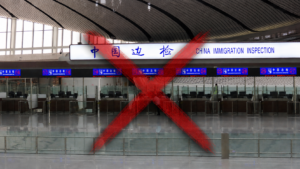
China’s new exit-entry regulations, set to take effect next month, expand the government’s authority to bar people from leaving the country and allow authorities to withhold notice of those restrictions in some cases, raising concerns among human rights advocates.
Issued by China’s State Council on July 31, the rules are presented as measures to “safeguard national sovereignty, security and development interests,” according to a press release. Human rights advocates, including ChinaAid President Bob Fu, argue the broad language allows authorities to target peaceful activities under the banner of national security.
“This new policy will further silence free speech and restrict travel to and from China,” said Fu, founder of ChinaAid. “Even more so than today, we will see peaceful political expression, religious activities, cooperation with international organizations, and even routine academic exchanges and media interviews treated as ‘national security’ threats by China.”
Under the regulations, individuals whom authorities determine have engaged overseas in activities deemed harmful to China’s “national security” or “national interests” may be barred from leaving China for six months to three years after returning.

Fu said it’s “troubling” how the new regulations will restrict groups already targeted by Chinese authorities, including religious communities, human rights defenders, journalists, scholars, and political activists.
Advocates also warn that provisions involving export controls and technology transfers could broaden the impact to researchers, entrepreneurs, and business professionals.
Under the revised policy, authorities are permitted to withhold notice of an exit ban whenever they invoke national security or criminal investigations. This could have the effect of depriving affected individuals of transparency, due process, and meaningful judicial remedies.
The U.S. State Department has warned Americans about China’s use of exit bans. Its China travel advisory states U.S. citizens “might only become aware of an exit ban when they attempt to depart the PRC,” with limited ability to challenge the restriction through the legal system.
The new regulations further require immigration-related intermediary agencies to register with the government and report relevant information, expanding state surveillance over citizens’ international travel and cross-border activities.

For years, ChinaAid has documented how the Chinese Communist Party (CCP) has increasingly used exit bans as a tool of political pressure, political persecution, and transnational repression, including in the case of Pastor John Cao, a missionary who holds U.S. permanent residency yet has been kept from returning to his family in the U.S.
Numerous house church pastors, human rights defenders, ethnic minority leaders, business executives, and even foreign company employees have already experienced arbitrary restrictions on their freedom to leave China.
“These new regulations demonstrate that the CCP is moving to transform exit bans from an administrative practice into a fully institutionalized mechanism of political control,” said Fu. “Freedom of movement is no longer treated as a fundamental human right, but as a political privilege granted — or withdrawn — at the discretion of the Communist Party.”
ChinaAid said the regulations raise concerns for overseas Chinese nationals who have criticized the CCP and considering travel to China. “Once inside China, the ability to leave again may depend less on the rule of law than on political determinations made by authorities,” said Fu.
Article 13 of the Universal Declaration of Human Rights affirms that “Everyone has the right to leave any country, including his own, and to return to his country.” Yet advocates say these new exit-entry policies conflict with those principles.
“The new regulations move China further away from internationally recognized human rights norms,” said Fu. “We urge the Chinese government to cease abusing the concept of national security to restrict freedom of movement.”
ChinaAid calls upon democratic governments, the United Nations human rights mechanisms, and the international community to closely monitor the implementation of these regulations and their impact on fundamental freedoms.
Founded in 2002, ChinaAid is an international Christian human rights organization committed to promoting religious freedom and the rule of law in China through advocacy, legal support, and international awareness campaigns.
Media Contact:
ChinaAid Association
Email: media@chinaaid.org
Website: www.ChinaAid.org