
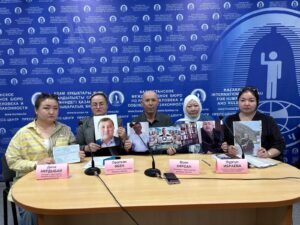
(Zhetysu, Kazakhstan — April 13, 2026) On Monday, a court in southeastern Kazakhstan’s Zhetysu region issued verdicts against 19 activists and supporters affiliated with the human rights organization “Atajurt Kazakh Human Rights.” The individuals had been charged after taking part in a protest calling on the Chinese government to release a Kazakh citizen detained in Xinjiang.
According to the verdicts, several defendants were sentenced to up to five years in prison, while others received varying terms of “restricted freedom.” Detained defendants were not brought into the courtroom; only those under house arrest were allowed to attend the sentencing in person. This arrangement has further intensified concerns over the fairness of the judicial process.
Some family members and supporters expressed strong dissatisfaction with the verdicts and staged protests outside the court.
From Protest to Harsh Sentences
The case stems from a protest on November 13, 2025. During the demonstration, activists publicly burned a Chinese national flag and a portrait of China’s president, demanding the release of detained truck driver Alimnur Turganbay.
Under Kazakhstan’s law, burning a foreign flag or an image of a political figure does not, in itself, constitute a criminal offense. However, prosecutors pursued charges of “inciting ethnic hatred,” which carry a maximum penalty of 10 years in prison.
Many observers argue that this classification is highly controversial, as it effectively transforms political expression directed at a foreign government into a domestic criminal offense.
Opaque Procedures and Unusual Judicial Practices
The trial process has also drawn scrutiny. Proceedings were conducted behind closed doors, with participants required to sign confidentiality agreements. A heavy police presence surrounded the courthouse, reinforcing a heightened sense of security.
More controversially, evidence indicates that Chinese authorities issued a diplomatic note to Kazakhstan regarding the protest, and that this document was included in the criminal case file. The incorporation of a foreign government’s position into a domestic prosecution is considered highly uncommon.
During the trial, “expert testimony” of linguistics reportedly equated criticism of the Chinese government with attacks on the “Chinese nation,” further blurring the line between legal reasoning and political interpretation.
Human Rights Groups: A Systematic Crackdown on Free Expression
Human rights organizations, including ChinaAid, have condemned the verdicts and believe that the activists’ actions constitute protected political expression rather than criminal conduct.
Human Rights Watch had previously warned that this case represents the first large-scale use of criminal charges in Kazakhstan against activists advocating on Xinjiang-related issues, and called for the charges to be dropped.
Critics say the arrests, prosecutions, and sentencing reflect a growing suppression of free expression in Kazakhstan, particularly on issues related to Xinjiang.
Judicial Choices Under Geopolitical Pressure
At the heart of the controversy lies not only the fate of the individuals involved, but also the broader political context.
For years, the “Atajurt” organization has gathered testimonies and documentation exposing detentions and re-education camps in Xinjiang, making it a highly sensitive group in the eyes of the Chinese government.
Analysts note that Kazakhstan faces a difficult balancing act: maintaining strategic ties with China while responding to domestic concerns and international human rights pressure.
This case is therefore seen as a critical test—not only of the fate of the 19 defendants, but also of Kazakhstan’s judicial independence and its commitment to human rights.
Selected Sentences (Excerpt)
Among the announced verdicts:
Bekzat Maxutkan, a leader of the organization, was sentenced to five years in prison.
Activists Tursynbek Kabi, Yerkinbek Nurakyn, and others were also sentenced to five years in prison.
Several supporters received five-year prison terms or restricted freedom sentences.
Some female defendants had their sentences deferred due to caregiving responsibilities for minor children.
An Unfinished Case
Although verdicts have been delivered, the political and legal repercussions of the case continue to unfold.
For critics, this is not only a trial of individuals, but a redefinition of the boundaries of speech: in contemporary Central Asia, can a citizen face criminal punishment for criticizing another country’s government?
So far, Kazakhstan has not provided a convincing answer.
Gao Zhensai, Special Correspondent for ChinaAid
Appendix:
- Bekzat Maxutkan, a leader of the Atajurt organization, was sentenced to 5 years in prison.
- Nazigul Maksutkan, sister of Bekzat Maxutkan and a lawyer in the Atajurt movement, was sentenced to 4 years and 8 months of restricted freedom.
- Guldaria Sherizat, wife of Kazakh truck driver Alimnur Turganbay, detained in Xinjiang: sentenced to 5 years in prison; sentence deferred due to minor children.
- Gulnar Shaimurat, an Atajurt activist, was sentenced to 5 years in prison; sentence deferred due to minor children.
- Tursynbek Kabi, an Atajurt activist and former witness of Xinjiang re-education camps, was sentenced to 5 years in prison.
- Yerkinbek Nurakyn, an Atajurt activist, was sentenced to 5 years in prison.
- Yerbol Nurlybaev, an Atajurt activist, was sentenced to 5 years in prison.
- Margulan Nurdangazy, an online influencer and Atajurt supporter, was sentenced to 5 years in prison; his Facebook, Instagram, and TikTok accounts were shut down after his arrest.
- Kuandyk Koszhanov, an Atajurt supporter was sentenced to 5 years in prison.
- Bakytzhan Shugyl, an Atajurt supporter was sentenced to 5 years in prison.
- Batylbek Baikazy was sentenced to 5 years in prison.
- Kanat Turdybay, an Atajurt supporter, was sentenced to 5 years of restricted freedom.
- Asylkhan Kolkhaev, an Atajurt supporter, was sentenced to 5 years of restricted freedom.
- Ayan Kalymbek was sentenced to 5 years of restricted freedom; he requested a closed trial.
- Bakytnur Nurmukhan was sentenced to 5 years of restricted freedom (to be released).
- Bedelkhan Kabylashim was sentenced to 4 years and 8 months of restricted freedom.
- Nurkeldi Nursapa, an Atajurt supporter, was sentenced to 4 years and 8 months of restricted freedom.
- Akzhigit Beysenali was sentenced to 4 years and 8 months of restricted freedom (to be released).
Kazakh human rights activist Serikzhan Bilash provided the list above.