
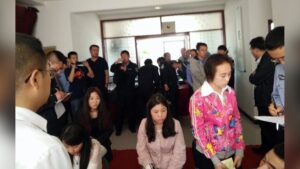
(Kunming — May 27, 2026) Authorities in Kunming, the capital of southwestern China’s Yunnan Province, have targeted a small Christian congregation composed primarily of marginalized people and believers with chronic illnesses.
According to a May 22 statement from the church and informed sources, authorities have intensified pressure on Century New Town Church in Kunming. During a Sunday worship service on April 12, local police raided the church and detained preacher Yu Shaolin, along with two other believers, Li Qin and Luo Ping.
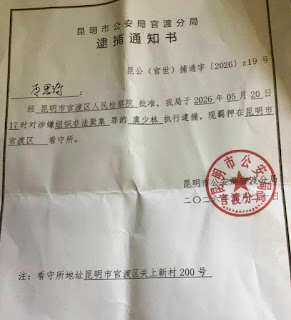
More than a month after their initial detention, the situation has intensified. On May 20, the Guandu Branch of the Kunming Public Security Bureau delivered arrest notices to the families detailing the charges against the men.
Authorities accuse the three of “organizing illegal gatherings,” a charge increasingly used against unregistered house churches in China in recent years. All three are being held at the Guandu District Detention Center in Kunming.
The case comes amid a broader crackdown against religious activities not officially sanctioned by the state. Since revised Regulations on Religious Affairs took effect in 2018, independent churches across China have faced raids, fines, and arrests of key members.
Unlike several large urban house churches closed in recent years, Century New Town Church is relatively small and has an unusual membership structure.
According to materials released by the church, it has just over 30 members, many of whom suffer from depression or cancer. Members describe the church as both a place of worship and a source of emotional and spiritual support.
Church members say preacher Yu Shaolin’s personal history reflects the congregation’s outreach to marginalized people. According to his testimony, Yu spent years involved in nightclub culture and struggled with substance addiction before later developing thalassemia and leukemia. After converting to Christianity, he reportedly overcame his addiction and became involved in evangelism among local drug users.
Yu Shaolin’s health condition remains critical. Family members say Yu suffers from severe lower-limb varicose veins – which cannot be treated surgically – liver damage and kidney insufficiency. They have expressed concern that his health may deteriorate in detention.
His wife, Li Siqi, who also suffers from chronic illnesses including adrenal tumors, is reportedly facing significant psychological and financial stress.
Authorities have also repeatedly summoned and questioned church members, according to sources familiar with the case.
Chinese authorities’ recent arrests of members of a small house church illustrate how the national crackdown on religious minorities has intensified. Sources who spoke to ChinaAid News, who requested anonymity for their safety, say it has generated fear and a chilling effect within local independent religious communities.
Despite significant legal risks, Century New Town Church issued a public appeal on Friday, urging human rights advocates and Christians in China and abroad to provide assistance. The statement noted that efforts are underway to secure defense lawyers for the three detained individuals, but the church faces high legal costs and possible official pressure on attorneys willing to take the case.
In recent years, lawyers handling religious and human rights cases in China have faced increasing risks of losing their law licenses or being subjected to imprisonment.
As of publication, the Guandu Branch of the Kunming Public Security Bureau had not responded to requests for comment. The timeline for formal prosecution and trial of Yu Shaolin and the other two detainees remains uncertain. In previous cases involving “illegal gathering” charges tied to religious activity, defendants have received multi-year prison sentences.
Gao Zhensai is a special correspondent for ChinaAid News. Founded in 2002, ChinaAid is an international, Christian nonprofit human rights organization that inspires, informs, and invites people to transformative action on behalf of persecuted people of all faiths in China.