
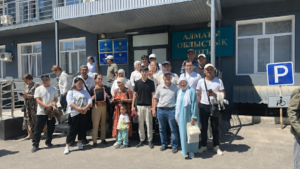
(Kazakhstan – June 10, 2026) A regional court in Kazakhstan, a Central Asian country bordering China, upheld the convictions of 19 members and supporters of the Atajurt Kazakh Human Rights organization on June 9, rejecting appeals in a case that has drawn international scrutiny over allegations of Chinese diplomatic pressure and transnational repression.
The case stems from a Nov. 13, 2025 protest near the Kazakhstan-China border in support of Kazakh truck driver Alimnur Turganbay, who had been detained by Chinese authorities in Xinjiang. During the demonstration, participants burned a Chinese national flag and a portrait of Chinese leader Xi Jinping.
After the protest, China’s Ministry of Foreign Affairs submitted a diplomatic note to the Kazakh government. Authorities subsequently arrested 19 participants, including 18 Atajurt members. The case was initially treated as an administrative offense before being elevated to criminal charges under Article 174 of Kazakhstan’s Criminal Code, which addresses “incitement of ethnic or national discord.”
The regional court in Konaev, in Kazakhstan’s Almaty Region, upheld the original verdict and dismissed all appeals. According to the ruling, 11 defendants received five-year prison sentences, while the remaining eight were sentenced to four years and eight months of restricted freedom, a non-custodial punishment.
All 13 male defendants were held in pretrial detention during the proceedings. Following sentencing, nine were sent to prison and four received restricted-freedom sentences. The six female defendants had been under house arrest; two received suspended prison sentences and four were sentenced to restricted freedom.
Prosecutors alleged that the defendants incited ethnic hatred against Chinese nationals through their protest activities, thereby violating Article 174.
Serikzhan Bilash, founder of Atajurt Kazakh Human Rights, said Article 174 has long drawn criticism from domestic and international observers. He noted that multiple human rights organizations and United Nations mechanisms have questioned the provision’s broad scope and application.
Two diplomats from the U.S. Embassy in Kazakhstan attempted to observe the June 9 proceedings but were denied entry after the court designated the appeal hearing as closed. According to participants, the diplomats said they would continue monitoring the case and report developments to Washington.

(Photo taken in Taldykorgan on March 16, 2026)
Defense lawyer criticizes evidence and prosecution
Following the ruling, defense counsel questioned the legality and fairness of the convictions, arguing that the forensic linguistic report relied upon by prosecutors was flawed and lacked professional objectivity. The attorney alleged that experts selectively interpreted statements made during the protest and removed them from context to characterize the defendants’ remarks as incitement of ethnic hatred.
The defense also argued that investigators failed to adequately examine key video evidence and cited factual errors in the report, including the alleged misidentification of individuals involved in the protest. The attorney further contended that several Atajurt members had already received administrative penalties for the same conduct before criminal proceedings were initiated, raising concerns about double jeopardy.
Defense counsel additionally questioned the proportionality of the sentences, noting that Article 372 of Kazakhstan’s Criminal Code provides a maximum penalty of a fine for desecrating Kazakhstan’s own national symbols.
The attorney argued that imposing five-year prison terms in a case involving the burning of a foreign flag was difficult to reconcile with that standard and described the verdict as among the most legally unfounded judgments he had encountered in 35 years of legal practice.
Rights advocates raise concerns over Chinese influence
The case has drawn concern from international human rights observers, some of whom argue that Kazakhstan’s judicial system came under political pressure after China submitted a diplomatic note following the November 2025 protest. Critics contend that the prosecution reflects a broader pattern of Chinese transnational repression extending beyond its borders.
Observers further argue that the case raises questions about Kazakhstan’s judicial independence and its commitment to protecting freedom of expression and peaceful assembly. They note that the defendants were prosecuted after participating in a protest aimed at drawing attention to the treatment of ethnic Kazakhs and other minorities in China’s Xinjiang region.
Civil society groups, diplomatic observers, and human rights advocates say they will continue monitoring the case and urging Kazakh authorities to release the imprisoned Atajurt members. They argue that the outcome will remain an important test of Kazakhstan’s willingness to protect fundamental rights despite external political pressure.
Gao Zhensai is a special correspondent for ChinaAid News. Founded in 2002, ChinaAid is an international Christian human rights organization committed to promoting religious freedom and the rule of law in China through advocacy, legal support, and international awareness campaigns.