
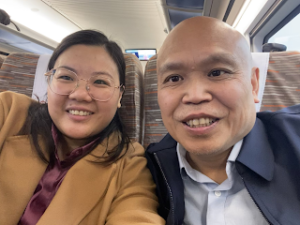
(Beijing – April 16, 2026) After enduring a second lengthy prison term, prominent Chinese human rights lawyer Yu Wensheng (余文生) returned to his home in Beijing this Monday. However, for this legal advocate, who has repeatedly challenged the government’s boundaries, the opening of the prison gates may be just the beginning of another form of surveillance and restriction.
Yu Wensheng’s wife, Xu Yan (许艳), confirmed the news on the social media platform X on Sunday: “Lawyer Yu Wensheng has returned to Beijing. Thank you all for your attention and support.” This brief message marks the end of a phase of a three-year international rescue campaign, but the shadow hanging over this long-suffering family remains.
Arrest and Trial Surrounding a Diplomatic Visit
The turning point in the lives of Yu Wensheng and Xu Yan came in April 2023. At the time, the EU’s top diplomat, Josep Borrell, and then German Foreign Minister Annalena Baerbock were visiting Beijing. The couple had planned to meet with the European Union delegation in China, but were intercepted by police on the way.
What was intended as a diplomatic engagement ultimately turned into a legal disaster. In October 2024, a court in Suzhou sentenced Yu Wensheng to three years in prison for “inciting subversion of state power.” Xu Yan was also sentenced, receiving one year and nine months.
The “Invisible Shackles” Behind Freedom
Although Xu Yan was released earlier this January, she has described to the outside world a nearly suffocating living condition. Authorities’ surveillance of her and her son did not end with the completion of her sentence. In addition to constant tracking and harassment, despite having passed the legal qualification exam, Xu Yan has been indefinitely denied her certification, effectively stripping her of the right to practice law and sustain a livelihood.
What has been particularly heartbreaking is the case’s impact on the next generation. When the couple was arrested in 2023, their son had just turned 18. According to human rights organizations, prolonged separation and the pressure faced by his parents have severely affected the young man’s mental health.
A History of Challenging the System
Now in his 50s, Yu Wensheng is a symbolic figure among China’s rights defense lawyers. He has taken on highly sensitive cases, including representing colleagues targeted in the “709 crackdown.”
This is not his first imprisonment. In 2014, he was detained for 99 days for supporting Hong Kong’s Occupy Central movement. In 2018, after issuing an open letter calling for constitutional reform to abolish presidential term limits, he was arrested again and imprisoned for four years. In 2018, Germany and France jointly awarded him the Franco-German Prize for Human Rights and the Rule of Law in recognition of his courage in the legal field.
Collective Calls from the International Community
Upon Yu Wensheng’s return to Beijing, 25 human rights organizations, including Amnesty International, Human Rights Watch, and several European bar associations, issued a joint statement.
The statement reflects international concern over China’s practice of “release into de facto house arrest.” The signatories urged Chinese authorities to:
Ensure full freedom: End all unlawful surveillance and restrictions on Yu Wensheng and his family.
Return to the rule of law: Restore Xu Yan’s right to practice and provide judicial remedies for prior arbitrary detention.
Uphold human rights obligations: Investigate alleged abuse and mistreatment Yu Wensheng suffered during detention and hold those responsible accountable.
Release alone is not enough; the statement also asks the Chinese authorities to stop using the law as a tool to punish dissent and respect their human rights commitments as a member of the United Nations.
For Yu Wensheng, the streets of Beijing may now feel unfamiliar, but the watchful eyes surrounding him remain cold. In the months ahead, whether he can truly exercise the constitutional rights to freedom of movement and expression will serve as a key window into the state of human rights in China.
Gao Zhensai, Special Correspondent for ChinaAid