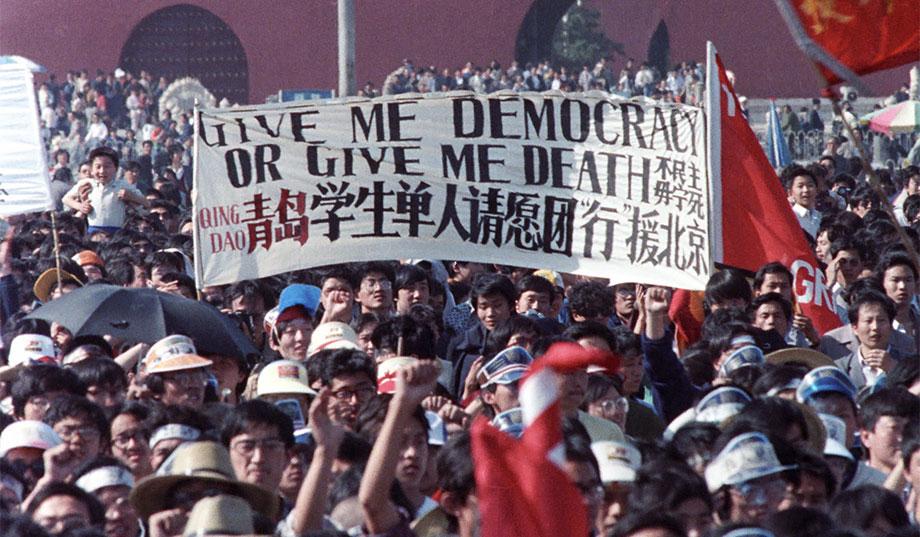

When the Tiananmen protests began, Dr. Liu, then a visiting scholar at Columbia University, raced back to support them. The PRC arrested him for his activism and sentenced him to two years in prison. In 1996, the party subjected him to three years of “reeducation through labor” for continuing to question China’s single-party system.
In 2008, Liu, along with more than 350 Chinese intellectuals and human-rights advocates, penned Charter 08, which consists of 19 specific demands on the PRC, including abandoning one-party rule and securing freedom of association, assembly, expression, and religion.
Two days prior to Charter 08’s release, the PRC detained Liu. He was jailed for over a year and, before the Beijing No. 1 Intermediate People’s Court, later pled not guilty to “inciting subversion of state power.” The court did not allow Liu’s defense to present evidence, and he was sentenced to eleven years in prison, with an additional two years’ deprivation of all political rights.
In October 2010, Liu Xiaobo received the Nobel Peace Prize for his role in Charter 08. He accepted in absentia, boldly declaring:
Hatred can rot away at a person’s intelligence and conscience. Enemy mentality will poison the spirit of a nation, incite cruel mortal struggles, destroy a society’s tolerance and humanity, and hinder a nation’s progress toward freedom and democracy. That is why I hope to be able to transcend my personal experiences as I look upon our nation’s development and social change, to counter the regime’s hostility with utmost goodwill, and to dispel hatred with love.
Liu’s courage poses a challenge to the free world, and the liberty he champions is possible for all the Chinese people. From Tiananmen Square to Taiwan, the evidence is clear that they desire — and are capable of — democracy. We must not marginalize Dr. Liu and his brave fellow dissidents but rather should make their plight central to our dealings with the PRC.
We should follow the example of Ronald Reagan, who stood up to the Soviet Union’s oppression of dissidents. He understood that the upholding of human rights was not a disinterested good deed — it was a vital edge that the Americans had over the Soviets. In 1984, President Reagan worked with Congress to rename the street in front of the Soviet embassy “Andrei Sakharov Plaza,” to provide the Soviet government a constant reminder of this advantage.
In this tradition, and in solidarity with the Chinese people, I introduced legislation to name the portion of International Plaza in front of the PRC embassy in Washington, D.C., “Liu Xaiobo Plaza.” Earlier this year, the Senate passed this legislation unanimously. The House should do the same.
If it is passed into law, the Chinese ambassador would look at this street sign each day. This address would be on every piece of correspondence going into and out of the embassy.
The process to rename International Plaza was initiated two years ago, on the 25th anniversary of the massacre. If the House follows the Senate’s lead, this important legislation will go to President Obama’s desk.
Sadly, President Obama has threatened to veto the bill, bowing to objections by the PRC. I hope he will reconsider, to prevent the shameful spectacle of the 2009 Nobel Peace laureate rejecting an attempt to honor his unjustly imprisoned successor.
The lesson of Tiananmen Square is that you do not reform authoritarian regimes by enriching them while leaving their crimes against their own people unmentioned. You do it by raising these issues again and again, even if it causes occasional discomfort in diplomatic circles. It is well past time that we recognize this truth, and I hope and pray that next year we can honor this anniversary under a sign bearing Liu Xiaobo’s name.
—
Ted Cruz is the junior U.S. senator from Texas.
China Aid Media Team
Cell: (432) 553-1080 | Office: 1+ (888) 889-7757 | Other: (432) 689-6985
Email: [email protected]
For more information, click here