
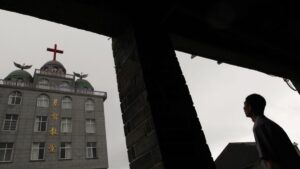
The demolition of Yazhong Church (also known as “Yayang Church”) in eastern China was carried out in less than 72 hours amid sweeping security measures and high-tech surveillance by local authorities and Chinese Communist Party (CCP) officials, according to a local source.
The source, speaking anonymously for security reasons, described how authorities in Yayang Town, Zhejiang Province, sealed off the area, reportedly monitored electronic communications and demolished the prominent church in Wenzhou. This incident followed months of escalating tensions between congregants and local officials, as ChinaAid News previously reported.
To protect those involved, the names of both the interviewer and interviewee have been withheld and it has been lightly edited for clarity. The interviewee is identified throughout this report as “Mr. A.”
Demolition of a landmark church
Interviewer: Could you describe what happened on the day Yazhong Church was demolished?
Mr. A: The atmosphere that day was extremely terrifying. The street was filled with special police and officers. Several days before the demolition, Taishun authorities sealed off the area around the church. Barricades and checkpoints were established one to two kilometers from the site, and only authorized personnel were permitted to be nearby or to take photographs.
The most alarming aspect was their surveillance methods. The government reportedly deployed “thermal infrared imaging” detection equipment (the exact device name is unclear). It was said that detection systems were set up within a two-kilometer radius.
Days before the demolition even began, individuals working with local authorities were stationed in all the nearby high-rise buildings to monitor the area, and residents were forcibly relocated.
In the past few days, heavy construction vehicles have been hauling away the rubble, trying to leave behind no trace at all.
Interviewer: We’ve heard the authorities implemented an “information blockade” at the scene. How did those restrictions affect local residents and church members?
Mr. A: The monitoring of electronic devices by law enforcement at the scene was completely militarized. If you took out a mobile phone near the church, or were even suspected of taking photos, you would immediately be stopped, have your phone inspected, or even detained on the spot.
In church WeChat groups, members are now afraid to even send a message, emoji, or image related to Yazhong Church. Under this kind of technologically intensive surveillance, before you even have time to send a photo out, you may already be located through backend monitoring and summoned immediately.
Interviewer: Do you know exactly when Yayang Church was demolished?
Mr. A: The local government moved into the church on May 17. Before demolition began on May 18 at 10 a.m., all nearby residents had already been evacuated. Believers were forced to disperse to their homes, where they fasted and prayed in silence.
Between 10 and 11 a.m. Beijing time on May 19, the church’s main sanctuary was demolished.
Standing firm in their faith, despite demands
Interviewer: Why does the historical background of Yazhong Church matter? And what exactly triggered this conflict between the local authorities and the church?
Mr. A: To understand this incident, one must first understand the uniqueness of Yazhong Church. It is a part of the “Local Church” movement (also known as the “Assembly Movement”), whose faith tradition traces back to the renowned early twentieth-century Chinese preacher Watchman Nee and has deep historical ties to the British Closed Brethren movement. Wenzhou’s local churches have long maintained independent traditions and distinct identities.
Due to its remote, mountainous location in southern Zhejiang, Yazhong Church has historically remained distant from local government authorities. The conflict escalated sharply beginning last summer, triggered by local officials’ demand that the Chinese national flag be displayed inside the church sanctuary and that a flagpole be installed.
For believers, this was unprecedented and was seen as a violation of the purity of their faith. They strongly resisted this mixing of politics and religion. In June 2025, government personnel of Yayang Town, Taishun County, attempted to forcibly install a flagpole on the church exterior wall, triggering collective protests by believers and leading to a months-long stalemate.
The church building was a fully legal structure with official government approval. Now this forced demolition has been carried out as a unilateral action by the authorities.
Escalating pressure and limited legal options
Interviewer: Since this was a legally approved church, how did the authorities legally characterize the situation and proceed with the arrests? What is the current situation facing the believers and church leaders?
Mr. A: The local authorities adopted a step-by-step strategy of clearing the site first, then criminal detention, and, finally, forced demolition. Starting ten days before Christmas last year, on December 15, 2025, authorities in Wenzhou, Zhejiang, mobilized large numbers of special police and riot-control forces to conduct coordinated “inspection operations” at 12 gathering locations (assemblies) in Yayang Town.
At that time, Yazhong Church was the primary target of suppression. Under the cover of night, government personnel launched what resembled a military-style siege involving approximately a thousand personnel, while drones appeared over the church, conducting surveillance. Police dogs entered the church and searched aggressively. More than one hundred believers were forcibly dispersed and briefly detained. Members of the congregation responded by singing hymns.
The operation escalated as authorities targeted key church members. Currently, 22 believers, including church leaders Lin Enzhao and Lin Enci, have reportedly been held in long-term criminal detention. Authorities accused them of “picking quarrels and provoking trouble,” a charge frequently used by the CCP against activists and independent groups.
Lin Enci and Lin Enzhao faced severe persecution for refusing to consent to the flag installation, and Enci’s father also refused to compromise. The government offered two million RMB (approximately USD $290,000) in compensation for an agreement to demolish the church, but Enci’s father declined.
Of the 22 detainees currently in custody, some have even been denied meetings with defense lawyers. After the arrest of legally knowledgeable core members, local channels for legal relief have become extremely limited.
International pressure and religious freedom
Interviewer: Wenzhou has long been viewed as one of the region’s most aggressive in implementing religious policy over the past decade. From 2014 to 2016, it experienced an intense campaign of forced cross removals in which more than 1,000 church crosses were dismantled. From the perspective of local believers, why would authorities spend such enormous resources just to demolish a church?
Mr. A: Privately, people believe the demolition was not motivated by commercial interests. The site may simply become a public park. The true objective appears to be the elimination of an independent faith community that resists official control. Many are troubled that such a large-scale operation could be conducted so quietly, with little public awareness, which reflects the impact of technological authoritarianism.
Interviewer: Some observers question whether international diplomatic engagement – such as U.S. President Donald Trump’s recent visit to China – has improved religious freedom in China. What is your perspective?
Mr. A: This is indeed a very cruel reality. From current signs, visits by American delegations and high-level interactions do not appear capable of bringing substantial improvements to religious freedom inside China.
At most, such visits may result in the release of a pastor as a symbolic diplomatic gesture toward the United States. But, in diplomacy, competition between major powers is often dominated by trade interests such as raw materials and airplanes.
Local authorities may even take advantage of the situation, believing that as long as economic concessions or trade deals are offered, Western pressure on human rights and religious freedom issues will be diluted. This, in turn, emboldens local authorities to implement restrictions with even greater recklessness.
For ongoing updates and archives on this case, visit ChinaAid’s coverage of the Yayang Assembly.
Gao Zhensai is a special correspondent for ChinaAid News. Founded in 2002, ChinaAid is an international, Christian nonprofit human rights organization that inspires, informs, and invites people to transformative action on behalf of persecuted people of all faiths in China.