
By Josh Shepherd
(Washington, D.C. — November 20, 2026) Former U.S. Sen. Sam Brownback called his vote to grant China permanent normal trade relations “the worst vote I cast while I was in the United States Senate.”
Now he wants Congress to reverse that decision and make religious freedom a condition of favorable trade with China. He argues that a quarter-century of economic engagement has failed to produce the promised reforms.
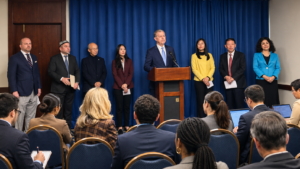
Brownback, a former U.S. ambassador-at-large for international religious freedom, announced the China Freedom Alliance at a Nov. 17 press conference at the National Press Club in Washington, D.C. He said 14 organizations had joined the coalition.
The alliance calls for revoking China’s permanent normal trade relations (PNTR) status and restoring annual congressional reviews, conditioned on measurable improvements in human rights and religious freedom. Congress approved PNTR in 2000, believing closer economic ties would encourage political openness.
Chinese pastors face imprisonment, restrictions
Rev. Dr. Bob Fu, founder and president of ChinaAid, said more than two decades of documenting persecution have shown the opposite outcome.
“Today, that persecution is not diminishing—it is intensifying,” Fu said. He cited pressure on Catholic bishops and priests to submit to Communist Party control and imprisonment of Protestant house church leaders.
Among those named was Pastor John Cao, a longtime U.S. permanent resident who remains barred from returning to his family after completing a seven-year prison sentence. Cao, 67, has advanced prostate cancer and has appealed to Chinese authorities to let him leave.
Fu also highlighted Pastor Gao Quanfu, 69, of Light of Zion Church in Xi’an, Shaanxi Province. Gao faces a possible 12- to 13-year sentence on fraud charges involving church offerings. His Nov. 12 trial ended without a verdict.
Pastor Wang Yi, leader of Chengdu’s Early Rain Covenant Church, remains imprisoned amid concerns about his health. ChinaAid has reported unconfirmed information suggesting he may have advanced liver cancer; his wife, Jiang Rong, has reportedly been permitted only five visits during his imprisonment.
“These are not isolated incidents,” Fu said. “They reveal a deliberate campaign to crush religious freedom.”
Broad coalition demands accountability
Rushan Abbas, executive director of Campaign for Uyghurs, described the imprisonment of her sister, retired physician Gulshan Abbas, since 2018. She also warned that China’s repression extends overseas through threats and intimidation of dissidents.
“Behind every trade agreement with Beijing are human lives at stake,” Abbas said.
Frances Hui of the Committee for Freedom in Hong Kong Foundation described a less visible crackdown: government influence over religious institutions even as churches remain open. She cited imprisoned Catholic publisher Jimmy Lai and Christian democracy advocate Joshua Wong.
“Religious freedom can be taken away long before the churches are closed,” Hui said.
Nina Shea, director of the Hudson Institute’s Center for Religious Freedom, described Beijing’s “sinicization” policy as a drive to impose ideological conformity on religious communities. Sophie Luo, whose husband, human rights lawyer Ding Jiaxi, is imprisoned, urged the release of prisoners of conscience.
Brownback suggested Helsinki Accords-style negotiations linking trade, security, and human rights. The alliance launched before President Donald Trump’s Nov. 19 summit with Chinese leader Xi Jinping and Russian President Vladimir Putin in Shenzhen, which produced no publicly announced commitments on religious freedom.
The call comes as lawmakers prepare for a new Congress. On Nov. 17, Sen. Tammy Baldwin, D-Wis., introduced the Ending China’s Special Treatment Act, which would revoke PNTR and impose higher tariffs on Chinese imports one year after enactment. Her bill emphasizes American workers and unfair trade practices, rather than the alliance’s proposed annual human rights reviews.
Fu urged Congress and the administration to attach economic consequences to religious persecution.
“Trade must serve freedom—not finance tyranny,” he said.
Josh Shepherd is editor of ChinaAid News. Founded in 2002, ChinaAid is an international Christian human rights organization committed to promoting religious freedom and the rule of law in China through advocacy, legal support, and international awareness campaigns.