
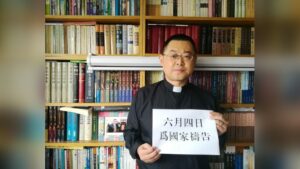
(Chengdu, Sichuan – June 5, 2026) As Chinese authorities tightened security around Beijing on the 37th anniversary of the Tiananmen Square crackdown, members of Early Rain Covenant Church, in Chengdu, the capital of Sichuan Province in southwestern China, reported a coordinated wave of police summonses, interrogations and home searches.
According to church statements and sources familiar with the situation, at least five ministers and congregants from the prominent house church were questioned by state security officers and police on June 4. The operation began around 7 a.m. and continued into the early hours of the following morning, with several church leaders subjected to lengthy interrogations and searches of their homes.
The timing drew attention because June 4, the anniversary of the Chinese government’s 1989 crackdown on pro-democracy demonstrators in Beijing, remains one of the country’s most politically sensitive dates. Authorities routinely increase security measures and surveillance around the anniversary, particularly among groups viewed as politically or socially independent.
Early Rain Covenant Church has remained one of China’s most closely watched house churches since authorities launched a sweeping crackdown against the congregation in December 2018. Its refusal to join the state-controlled Three-Self Patriotic Movement has placed it at the center of broader concerns about religious freedom and government control over religious communities.
June 4 security sweep targets church members
According to information obtained by ChinaAid from church sources, police first took minister Wu Wuqing and his wife from their home shortly after 7 a.m. on June 4. Officers later escorted the couple back to their residence and conducted a search before returning them to a police station, where they reportedly remained until around midnight.
Similar incidents were reported elsewhere in Chengdu. Minister Yan Hong was taken for questioning at approximately 1 p.m. and was not released until the following morning. Intern minister Jin Heng and congregant Li Zhong were also detained and interrogated for several hours before being released later that night.
Rights advocates say authorities increasingly use prolonged interrogations, home searches, temporary detentions and other forms of administrative pressure to disrupt the activities of unregistered Protestant congregations throughout China.
Key church leaders remain imprisoned
The June 4 operation came days after church member Ye Fenghua was permitted to return home on bail pending trial following a year in Residential Surveillance at a Designated Location, or RSDL, a detention measure that allows authorities to hold suspects in undisclosed locations for extended periods.
Human rights organizations and U.N. experts have criticized RSDL as a form of “enforced disappearance” because detainees are often denied meaningful access to family members and legal counsel. Sources familiar with Ye’s situation said his year-long detention resulted in physical and psychological effects, although his condition remains stable.
Despite Ye’s release, much of the church’s senior leadership remains in detention.
The church’s prolonged confrontation with authorities traces back to December 2018, when authorities launched a large-scale operation against the congregation. Pastor Wang Yi was later convicted of “inciting subversion of state power” and sentenced to nine years in prison, a charge frequently used against dissidents, activists and independent religious leaders. He is expected to complete his sentence in 2027 unless circumstances change.
Authorities launched another round of actions against the church on Jan. 6, 2026, targeting members in Chengdu and neighboring Deyang, another city in Sichuan Province. Elder Li Yingqiang, preacher Dai Zhichao and assistant deacon Jia Xuewei remain in detention, according to church sources, while their families and legal representatives report continued difficulties obtaining access to them.
Persistence amid adversity
Under President Xi Jinping, Chinese authorities have expanded efforts to bring religious groups, civil society organizations and other independent institutions under tighter state oversight. Officials describe the policy as the Sinicization of religion, an initiative intended to align religious practice more closely with Communist Party priorities.
Church members say that despite years of arrests, surveillance, evictions and restrictions on gatherings, the congregation continues to meet through small groups and encrypted communications.
In a recent statement, the church described its hardships as “light and momentary afflictions” endured for the sake of Christ. The statement also quoted the New Testament book of Acts: “rejoicing that they were counted worthy to suffer dishonor for the name.”
For Early Rain Covenant Church, the June 4 operation represented the latest chapter in a years-long confrontation between one of China’s most prominent house churches and authorities seeking to bring religious activity under closer state control.
Gao Zhensai is a special correspondent for ChinaAid News. Founded in 2002, ChinaAid is an international Christian human rights organization committed to promoting religious freedom and the rule of law in China through advocacy, legal support, and international awareness campaigns.