
(Analysis) In Chengdu, a heavily pregnant woman is raising two children alone while her husband, Preacher Dai Zhichao of Early Rain Covenant Church, has been held for more than four months without access to a lawyer. His formal charge is “inciting subversion of state power”; his real offense is preaching the Gospel outside the walls of state-sanctioned religion. Elder Li Yingqiang faces identical charges and is being held in the same detention center.
In Beijing, Pastor Ezra Jin Mingri, founder of one of China’s largest independent Protestant congregations, is formally under arrest. In a rural town in Wenzhou, the sanctuary where up to a thousand once worshiped now lies in rubble, demolished by local authorities who labeled the congregation a criminal syndicate.
These are not isolated cases. They are the visible edge of a calculated campaign to extinguish independent Christianity in China.
The Chinese Communist Party frequently boasts that its survival rests on its ability to “keep pace with the times” (yu shi ju jin). Yet its policy toward Christianity has moved in the opposite direction. Over the past two decades, despite China’s deep integration into the global economic system, the space for independent Christian worship has steadily and drastically shrunk. Under Xi Jinping’s leadership, this policy has shifted from containing house churches through state registration to actively reshaping Christianity under Party authority through mandatory Sinicization, criminal prosecution, and digital surveillance.
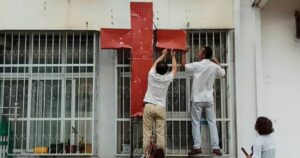
A highly visible turning point came between late 2013 and early 2016, when authorities carried out a coordinated cross-removal and church-demolition campaign in Zhejiang, a coastal region known for its large Christian population and thriving private sector. Authorities removed an estimated 1,500 to 2,000 church crosses from state-sanctioned sanctuaries.

This targeted campaign against registered Christian symbols laid the structural and ideological groundwork for the national policy of Sinicization launched in 2015. This ideological shift was subsequently institutionalized through law.
The revised 2017 Regulations on Religious Affairs, which took effect in 2018, significantly increased penalties for unauthorized religious activities. The updated framework tightened state control over church management, religious venues, finances, clergy, publications, collective worship, and online religious activity, while elevating national security and digital management into central enforcement tools.
By late 2018, the state deployed these expanded powers against some of the country’s most prominent Protestant house churches. Authorities targeted Beijing’s Zion Church, Chengdu’s Early Rain Covenant Church, and Guangzhou’s Rongguili Church through forced closures, property confiscation, harassment, and the coordinated detention of pastors and lay members. These actions signaled a decisive escalation against high-profile congregations that had previously survived within limited space outside the official church system.
This administrative grip tightened further in 2018 when the State Administration for Religious Affairs was absorbed into the United Front Work Department, placing religious affairs under more direct Party command. Concurrently, the state launched its ongoing Five-Year Plans for the Sinicization of Christianity. For the Chinese government, Sinicization does not merely denote cultural indigenization; it mandates conformity to socialist core values and unconditional submission to Party leadership.
The U.S. Commission on International Religious Freedom (USCIRF) has described this policy as embedding CCP ideology into religious life by installing loyal leadership, integrating state propaganda into doctrine, and criminalizing independent religious activity. This control expanded directly into the digital sphere with the 2025 Code of Conduct for Religious Clergy on the Internet, restricting unauthorized preaching, worship, training, religious outreach, or fundraising. In 2025 and 2026, a wave of renewed, coordinated crackdowns selectively targeted large-scale independent Protestant networks, marking a direct continuation of the 2018 enforcement efforts.
To achieve this suppression, Chinese authorities systematically weaponize the legal system through an escalatory framework. Enforcement typically begins with administrative allegations, such as registration, venue, finance, publication, internet, or construction violations. When a church remains organized, visible, or resistant to Party control, authorities escalate these administrative infractions into severe criminal prosecutions. Party officials calibrate this strategy precisely to neutralize leaders, dismantle independent networks, and intimidate believers.
Recent cases illustrate how systematically and ruthlessly authorities now prosecute independent churches. In October 2025, Reuters reported the nationwide detention of nearly 30 pastors and staff members from Zion Church, one of China’s largest independent Protestant congregations. Eighteen leaders, including founder Pastor Ezra Jin Mingri, were formally arrested for “illegally using information networks,” a charge punishable by up to three years. The charge targets the church’s use of online sermons and Zoom services to maintain ministry outside state control.
While the state used digital-related charges as a pretext against Zion Church, it leveled national security charges to silence the pastoral leadership of Early Rain Covenant Church in Chengdu. Current leader Elder Li Yingqiang and Preacher Dai Zhichao have been detained for more than four months as of May 2026 on charges of “inciting subversion of state power,” while being denied access to legal counsel, leaving Dai’s heavily pregnant wife to care for their two children alone. Their arrests follow the landmark December 2018 arrest of the church’s founder, Pastor Wang Yi, who is currently serving a nine-year prison sentence after a closed-door conviction for “inciting subversion” and “illegal business operations.”
The regime applied the same logic — different label — to Zhejiang’s Yayang Church, this time weaponizing anti-organized crime laws to mask its political motives. The congregation was targeted specifically for refusing to install state surveillance cameras and fly the national flag inside their sanctuary.

In December 2025, local authorities justified a massive political crackdown by framing the congregation as a “criminal syndicate,” deploying over 1,000 police officers, police dogs, and drones to arrest local believers. By May 2026, authorities completely demolished the main sanctuary under the pretext of clearing an “illegal structure.”
The current campaign against Christianity in China is a calculated legal and ideological effort to eliminate independent religious life entirely. The state does not merely suppress worship; it systematically criminalizes the very infrastructure that makes independent Christian communities viable — clergy, financial offerings, literature, education, digital fellowship, and property. Consequently, the core threat has evolved: the issue is no longer whether house churches are forced to register with the state, but that they are entirely forbidden from maintaining independent doctrine, leadership, finances, and community life outside state control. Given this trajectory, state hostility against independent Chinese churches will intensify in the foreseeable future.
The United States and its allies cannot afford to treat this as background noise. Past U.S. administrations have repeatedly invoked human rights at summits, then allowed it to vanish from the negotiating table; that pattern must end. U.S. leaders must name these pastors and these congregations by name in face-to-face meetings with Chinese officials, and make religious freedom a non-negotiable item in every bilateral summit.
Diplomatic and trade envoys must make clear that broader economic and geopolitical cooperation is inseparable from China’s compliance with international human rights standards. The State Department and Treasury have the tools: the Global Magnitsky Act exists precisely to sanction the provincial and local officials who ordered these raids, these demolitions, and these arrests.
Congress and allied parliaments must hold dedicated hearings to expose the CCP’s systematic abuse of anti-organized crime statutes and digital information laws as instruments of religious persecution. International religious institutions and human rights NGOs must form a unified front to publicly document and condemn the forced installation of state surveillance inside houses of worship.
And while these mechanisms build, diplomats must prioritize immediate demands for medical parole for leaders facing severe health crises, such as Beijing Zion Church’s Pastor Ezra Jin Mingri. Dai Zhichao’s wife should not have to raise their children alone; she should be watching her husband walk through the door.
This article has been updated and expanded.
Lauren Lau, Ph.D., is a graduate of Temple University in Philadelphia, Pennsylvania.